Hood to fan
Kitchen exhaust cleaned from the hood to the fan
Hood, baffle filters, grease duct, exhaust fan and make-up air, cleaned so the line is ready for the next day's service.
Where the grease settles between the hood and the fan
A commercial kitchen pulls hot, greasy air up through the hood every minute the line is cooking. As that air cools on its way out, the grease vapor condenses on the first surfaces it meets: the baffle filters, the walls of the hood plenum, the grease duct, and finally the exhaust fan housing on the roof or the wall.
None of that is visible from the kitchen floor. The filters can look fine while the duct behind them carries a layer that grows a little every service day. The fan housing is the clearest place to see what the whole run has been collecting, a thick coat of grease and mold on the scroll and the blades that no one has looked at in a long time.
That layer is fuel. It also narrows the path the air has to travel, so the fan works harder to pull less. Walk the system from the cooktop outward and every stage is a place for it to collect: the filters first, then the plenum, the long horizontal and vertical duct runs, and the fan at the end. Cleaning it is not cosmetic work. It is the part of the building that decides how much of the kitchen's smoke, heat and grease actually leaves the room.
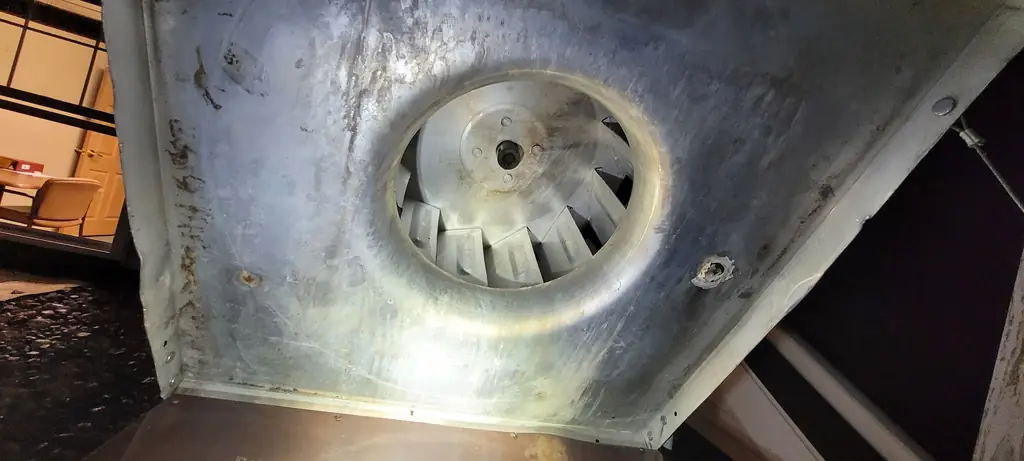
Inside a kitchen hood plenum looking up at the exhaust fan scroll after cleaning
The whole run, hood to fan, cleaned as one system
Metro Cleaning Service, Inc. cleans the exhaust system as a connected run rather than as separate parts. That means the kitchen exhaust itself, the grease systems, the hood, the ducts, the equipment under and around the hood, and the dishwasher exhaust and make-up air systems that move air in the opposite direction.
We also clean the floors, walls and ceilings around the work, because grease that gets cleaned off a duct and left on the ceiling tile above the line has only moved. Equipment gets cleaned along with the hood, so the space reads as one finished job when we are done. Nothing is left half-done at the filters while the duct behind them stays as it was.
The work is planned around your kitchen, not ours. Restaurants close at different hours and open on different mornings, so we schedule the cleaning to land after service ends, with the goal that your equipment is clean for the next day's use. For the air side of a building beyond the kitchen, the same crew also handles commercial air duct cleaning and dryer vent runs.
What a clean exhaust run gives the line
The first thing is a lower risk of a grease fire. A hood and duct coated in grease are exactly where a flare-up on the cooktop becomes a fire in the walls, which is why cleaning the full run is the point, not just wiping what shows. A hood that looks spotless from the line tells you nothing about the duct above the ceiling.
The second is compliance. Inspectors and insurers look at the state of the exhaust system, and a thorough cleaning of the full run is the straightforward answer to that conversation.
The third is airflow. With the ducts and fan clear, the hood captures what it is supposed to capture and the cooks work in a cooler, less smoky kitchen. After we have cleaned your work space, your cooks have a sanitized environment that they will appreciate and enjoy cooking in. Metro Cleaning Service, Inc. is licensed, bonded and insured, and has worked in Twin Cities buildings since 1968.
Metro Cleaning Service, Inc. Licensed, bonded and insured, since 1968. Call (651) 484-9799.
Everything on the exhaust side of the kitchen
This is the equipment list we clean for restaurants. If your kitchen also has roof-top air handlers or a laundry room, the commercial air duct work and the dryer vent runs are handled by the same people.
- Kitchen exhaust
- The run that carries the cooking air out of the building.
- Grease systems
- Where the vapor condenses and the build-up collects.
- Hood cleaning
- Canopy, plenum and baffle filters over the line.
- Ducts cleaning
- The grease duct from the hood to the fan.
- Floors, walls and ceilings
- The surfaces around the work, left clean.
- Equipment cleaning
- The equipment under and beside the hood.
- Dishwasher exhaust systems
- The steam and moisture side of the kitchen.
- Make-up air systems
- The fresh air that replaces what the hood removes.