Supply + return
Commercial air ducts cleaned along the whole air path
Supply and return runs, blowers and coils, cleaned with pressure washing, coil cleaning and inline methods.
What dirty ductwork costs a building
Every commercial building breathes through its ducts, and everything the air picks up on the way, dust, allergens, odor, settles somewhere in that network. When the supply and return runs are dirty, the building shows it in ways that rarely get traced back to the ductwork: stale air on one floor, uneven temperatures between offices, a coil that never quite keeps up.
Clean ducts improve indoor air quality and give you better airflow and temperature control. They mean less dust, fewer allergens and fewer odors moving through occupied space. The system also moves air with less effort, which shows up as energy savings, a longer life for the HVAC equipment and fewer breakdowns.
Facilities with long duct runs feel it most, because a small restriction repeated across hundreds of feet of duct becomes a large one. Those are the reasons facility managers call us. The air in a hospital wing, a school corridor or an office floor is only as clean as the path it travels, and that path is the part no one can see without opening it up.
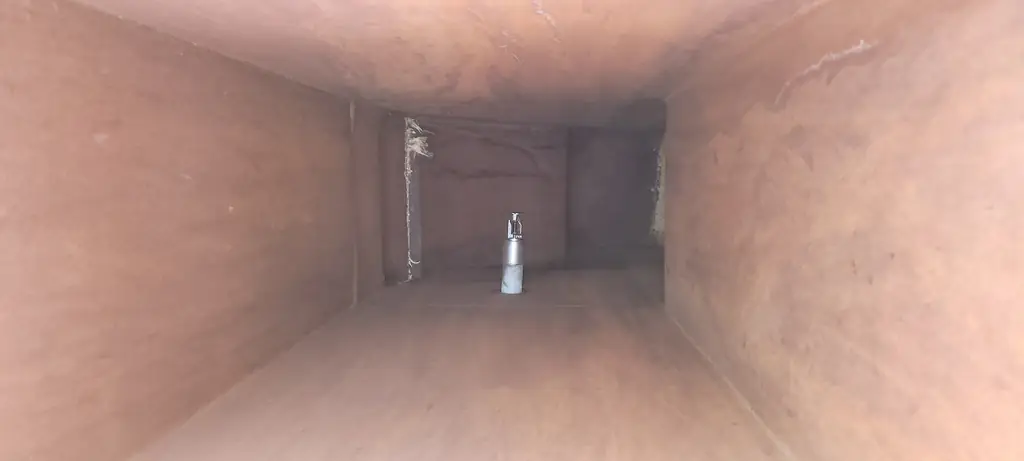
Looking down the inside of a cleaned rectangular sheet-metal duct toward the far opening
A plan for the whole air path, not a pass with a vacuum
Commercial duct cleaning is built around the system in front of us. We use pressure washing, coil cleaning and inline cleaning methods, chosen for the duct type, the access and the amount of build-up, and we work through the whole air path: the supply and return duct network, the blower components, the air handling units and the coils.
That range matters because a duct is only one piece of the loop. A clean run feeding a loaded coil or a dirty blower wheel just carries the problem to the next stop. Treating the duct network, the blowers, the air handlers and the coils together is how the cleaning holds up, and it is why we look at the whole system before we quote the job.
It also explains why a building's own maintenance staff cannot simply take this on between other jobs. The work calls for specialized equipment and training. If your kitchen exhaust is part of the same building, that run is a separate system with its own needs, covered on our page about kitchen exhaust and hood cleaning.
Scheduled around the people in your building
We clean for hospitals, schools, office buildings and other large commercial facilities, and those buildings do not stop for a service crew. That is why Metro offers flexible scheduling and 24/7 availability: overnight, early morning or weekends, whichever window leaves your occupants undisturbed. Nobody has to move a ward, a classroom or an office floor to fit our schedule.
How long it takes depends on the building. A smaller facility can be done in a few hours, while a large multi-floor building takes longer. Price follows the same logic: it depends on building size, duct configuration and system complexity, so every quote is free, with no obligation, and priced for your building.
Metro Cleaning Service, Inc. works out of Saint Paul and has served facilities across the Twin Cities for over 50 years. On the Minneapolis side that means the North Loop and the Warehouse District, Uptown, Linden Hills and Seward, and the central business district, along with Bloomington and the suburbs around it.
Metro Cleaning Service, Inc. Licensed, bonded and insured, since 1968. Call (651) 484-9799.
We don't just show up with a vacuum; we show up with a plan.
What cleaner ducts give the building
A cleaned duct network pays back in ways the occupants notice and the utility bill confirms. If the kitchen on the ground floor feeds its own exhaust run, see kitchen exhaust and hood cleaning, and for the laundry room in the basement, our dryer vent cleaning.
- Better indoor air quality
- Better airflow and temperature control
- Less dust, fewer allergens, fewer odors
- Energy savings
- A longer life for the HVAC equipment
- Fewer breakdowns